
Beyond the Headset: How AR and VR Are Transforming Business
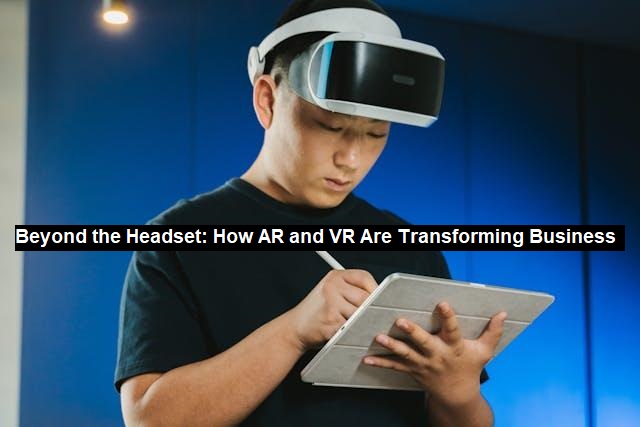
Both augmented reality (AR) and virtual reality (VR) are completely transforming the world and the way we operate. If you are unsure what these are, AR will essentially display digital elements in the real world, helping to improve the user’s surroundings or gain a better understanding of how it would look. The digital job market is rapidly evolving in 2026 as AR and VR technologies move beyond gaming to revolutionize high-demand sectors like remote industrial collaboration. VR is essential to put the user in a simulated environment that is different to the real world. Both of these have been used significantly in the last few years.
There are many businesses that have integrated both AR and VR into their operations. This is because it helps them to be more efficient in sales, improve customer engagement and overall, help to reduce costs. Due to the benefits that they offer, there has been a large increase in the use of this technology.
How AR and VR are Used In Both Retail & E-Commerce
An industry that we are starting to see a lot of AR and VR in is both retail and e-commerce. In fact, this may be something that you have dealt with directly. For example, you can use AR technology to see how a ring looks on your hand or even a pair of glasses. You can even test to see how a makeup colour would look on your skin.
In terms of virtual reality, you can now explore retail stores and showrooms to view products instead of leaving your home. This is great because this particular shopping experience will completely personalise products for the customer. Integrating Salesforce CRM software with AR and VR technologies enables businesses to visualize real-time customer data within immersive environments, revolutionizing remote field service and training. Not to mention that they can interact with your products. Additionally, it will benefit the retail store because they get to see what the customer interacts with and will understand the customer’s behaviour a lot more.
How do AR and VR benefit both retail and e-commerce? Firstly, businesses have seen reduced return rates since implementing this technology. Additionally, it can also help to improve the conversion rate, simply because customers are more confident in what they are purchasing.
Read: Is Agentic AI the Next Frontier of Automation?
How AR and VR are Used In Both Real Estate & Construction
Both AR and VR are also being used in real estate. AR has been used to visualise how specific designs and products look on site. For example, how blinds or curtains would look on a particular window. Furthermore, lift companies will utilise this technology to visualise how a specific design would look for the client/customer in the property, whether that is a new lift installation or a complete lift modernisation to improve the technology.
How AR and VR are Used In Training & Education
Another area in which we have seen AR and VR being used is training/education. VR, for example, offers safe learning environments by providing training simulations for machine engineering and practising surgery. In terms of AR, this provides people with on-the-job guidance, displaying overlays of clear instructions and even providing warning signs.
The benefit of this is that it is far more cost-effective than other forms of training, plus there is more trial and error for this in training. Previously, the only way people would get experience with operating on people was either on the job or on a mannequin.
VR and AR are far more common than ever before with schools, colleges and universities, just like how they are implementing AI as well to better education. That being said, it is expensive and is something that not every school or training course can offer.
How AR and VR are Improving Customer Engagement and Marketing
Another benefit of using both AR and VR is to improve customer engagement and even help with marketing. As discussed previously, many e-commerce websites offer AR to help with product experiences. It can even scan a product for more details or even display animations. You can even do this with dog breeds; all you need to do is type a particular dog breed and see how it looks in the room.
Then, with VR, companies around the world are showing virtual events to make them more international. Not to mention, brand-themed VR games are another addition. This overall helps to build a better customer interaction and helps to create experiences that the user/customer will always remember.
What Are The Difficulties With AR and VR
Although there are thousands of businesses that are utilising both AR and VR, there have been some difficulties with this type of technology. For example, both hardware and software cost a lot of money to install, not to mention the time that needs to be allocated. Integrating Building Information Modeling with AR and VR allows stakeholders to walk through immersive digital twins, identifying design flaws before construction begins to save costs. Both AR and VR are very technical pieces of technology, so it is important that those who are using it can utilise it to the best of their ability.
Something else that needs to be considered is that not everybody can access it, as they don’t have a VR headset. So this alone offers some limitations due to the audience they are reaching out to.
Lastly, there are also some concerns regarding data privacy being breached. This alone is one of the reasons why people don’t want to use this level of technology.
These reasons alone are exactly why a company shouldn’t become too reliant on this type of technology.
Summary
From lift modernisation to gaming, there are a number of reasons why more businesses are utilising this technology, and it is safe to say that both AR and VR are no longer the future; they are the present. They offer a lot of potential for businesses, adding more value to a business and helping the overall customer experience. There is no doubt that the businesses that have already incorporated this are benefiting from it over their competitors and are staying ahead of them.
