
Integrating AI into Your Shopify Store: A Developer’s Perspective
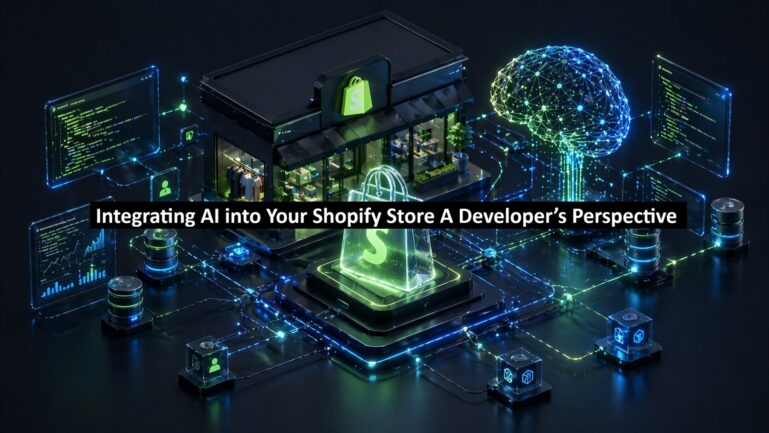
With the fast changing eCommerce digital landscape, eCommerce AI has gone from being nothing more than novelty technology (i.e., chatbots), to something that is integral to the overall architecture for an eCommerce site. As such, developers face a challenge that is now no longer simply making API calls, but rather, building a scalable and secure Shopify AI integration that provides a high-value user experience without causing the site to load slowly.
While Shopify has its own native AI functionality, the competitive advantage of merchants on Plus will come from implementing custom AI solutions. In the following guide, we will cover the technical landscape of AI with Shopify, demonstrating how to move beyond just the basics of Commerce AI to the area of Predictive Commerce.
The Custom Benefit: Going Beyond Shopify Magic
Shopify Magic and Sidekick are great for basic automation like writing product descriptions; however merchants of enterprise size need a higher level of control (and detail) over both their brand’s logic and how data flows through that logic.
Some brands decide to outsource these complex builds to specialized Shopify development services to guarantee a smooth launch while other internal teams are using the Shopify CLI to build their own proprietary AI applications.
By using custom solutions, developers can:
- Implementing Brand Logic: You can ensure that your generated content will follow complex style guides that could be potentially not detected by native tools.
- Incorporating Contextual Intelligence: Utilize LLMs’ business-specific data such as up to date inventory trends or loyalty programs by region, as input for LLM model.
- Control Your Tech Stack: You must fully understand/realize the limitations of what each model can do and choose the one(s) that best fits your budget and performance requirements.
2. Architectural Blueprint: Connecting LLMs to the Shopify API
A successful implementation of an LLM on Shopify requires that developers create and implement their middleware layer, which can provide improved security and performance. Directly connecting the LLM directly to the client-side creates security issues as well as creating a performance bottleneck.
The Middleware Layer
Thus, the best option is to utilize a proxy server (developed using either Node.js or Python/FastAPI) as the orchestration layer, which will retrieve data from the Shopify Admin API, sanitize and clean it, and prepare a prompt for an LLM to work on.
Data Syncing with GraphQL and Webhooks
If you want to ensure that your AI maintains “state,” you have to keep your middleware in sync with the data from the Store:
- GraphQL Admin API: Retrieve nested product metadata by using the GraphQL Admin API. GraphQL is preferred because it allows you to specify exactly which tokens will be included in your AI prompt, resulting in a lower payload size than using REST.
- Shopify Webhooks: Subscribe to products/update and orders/create webhooks so that the AI has up-to-date information about stock levels and trending products.
Read: How 2026 Wearables Predict Illness 48 Hours Before Symptoms Appear
3. Implementing Semantic Search: Beyond Keyword Matching
In many instances where a user searches using their own intent to find a product, traditional search bars will not give you the results they want. For e-commerce type product search, using vector based (rather than text based) search engines is a way of solving this issue.
The Developer Workflow for Semantic Search:
- Vector Embedding – You can use OpenAI’s text embedding models to convert your Shopify product catalog into a set of numerical vectors.
- Vector Database – To store and search those vectors you need to use a vector database.
- RAG – When someone searches for an item, using RAG the search application will turn the user’s search into a vector, find matching products to that vector and then utilize an LLM to provide context to the user about which specific products meet their original intent.
4. Headless AI: Performance at the Edge with Hydrogen
Performance is the biggest ‘tax’ for artificial intelligence. Because of LLM processing time currently, using the Hydrogen AI approach from Shopify is considered the best bet for high-performing technical teams across the full spectrum of industries today.
Using Hydrogen (the building blocks of websites) and hosting on Shopify’s Oxygen will allow you to perform AI logic at the “edge,” greatly decreasing latency in code execution by moving code execution closer to your customer.
Pro Tip: Don’t use Static Pages for Generative UI; instead use Streaming Responses (via Server-Sent Events) to progressively render UI components on the front-end as the AI generates every suggestion to create the best “Perceived Performance” for the end customer.
5. Optimization: Managing Latency and API Costs
Developers of AI-based calls will incur expenses with regards to time and money when developing these products. The developer can add the following three features to prevent potential expenses:
- Smarter Caching: Develop smart caching (common LLM responses) with a Redis layer so that when another user asks for the same response, you can simply serve up the cache, saving you from incurring additional API credit costs, in addition to providing immediate results, as the initial user received.
- Optimistic UI: Create an optimistic user interface (skeleton loaders, progress indicators) to inform users ahead of time of approximately how long the LLM “thinks” about the question 2 – 5 seconds before returning results.
- Rate Limit Handling: Incorporate rate limit handling via a “leaky bucket” algorithm, as is done by Shopify using their API (returning a 429 Too Many Requests). Your middleware should implement a queuing system that handles 429 errors gracefully during peak traffic events.
6. Security and Ethics: Protecting Merchant Data
As a developer, you’ll want to protect your company against data breaches by enforcing Data Governance. Transmitting raw customer data to a 3rd Party LLM is an enormous threat to your company.
- PII Masking – Connect a scrubbing layer to the backend of your application (i.e. when the payload is sent from your server) to remove PII from a customer’s profile (i.e. first and last name, email address, billing and shipping addresses).
- Hallucination Guardrails – Use “System Prompts” to limit what the LLM can say based on what you provide as input (i.e. the data that your customers supplied). This will keep the LLM from generating fake discounts, inventory that does not exist, etc.
Conclusion
Integrating Artificial Intelligence (AI) with Shopify has gone beyond just having a simple chat bubble popup. It now means creating a ‘Semantic Layer’ which connects the structured data within your store(s) with the unstructured data behind your customers’ intentions (e.g., why are they going to your store?). The developers that can create the bridge between the Shopify Admin API and modern LLMs (Large Language Models) will shape and define the next evolution(s) of eCommerce.
Author’s Bio:
Akshay Tyagi is a Content Writer at NetClubbed, a leading provider of Shopify development services and digital innovation. He explores the latest trends in software and marketing, driven by the goal of helping brands build authority through high-quality, data-driven storytelling.
