
Is Agentic AI the Next Frontier of Automation?
Introduction
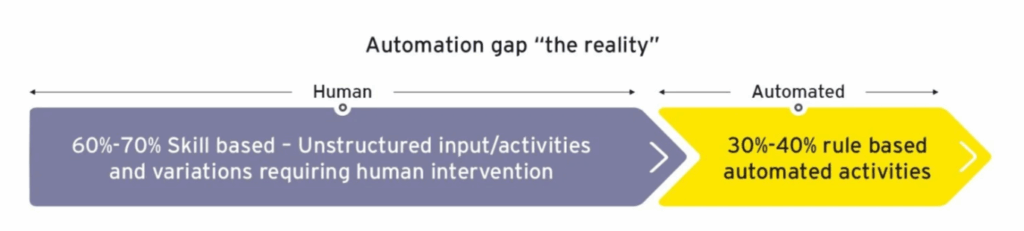
After a decade of RPA (Robotic Process Automation) implementations and AI pilots that overpromised but underdelivered, executive teams have developed automation fatigue, and for good reason. To master the next frontier of automation, companies must integrate agentic AI into their workflows to maximize and reclaim valuable hours for strategy. Traditional automation has always focused on the easy wins: those 30-40% of predetermined, rule-based tasks. However, the real value, which accounts for 60-70% of complex, skill-driven activities requiring human judgment, remained untouched, leaving a significant portion of operational costs and process inefficiencies unchanged.
So when your CFO instinctively dismisses the next ‘revolutionary’ automation pitch that will ‘transform operations’ as marketing fluff, their skepticism is most likely justified. However, while several boardrooms were discussing the next wave of enterprise automation, something quietly shifted in 2024. The technology capable of addressing that untouchable 60-70% wasn’t far along; it was already here, just not on most executives’ radars.
Agentic AI automation, which involves systems that reason, strategize, and execute complex workflows autonomously, has progressed beyond pilot experiments to become production-ready solutions. Read on to see how Agentic AI is a fundamental departure from traditional automation.
Understanding Agentic AI: Next Major Shift in Enterprise AI
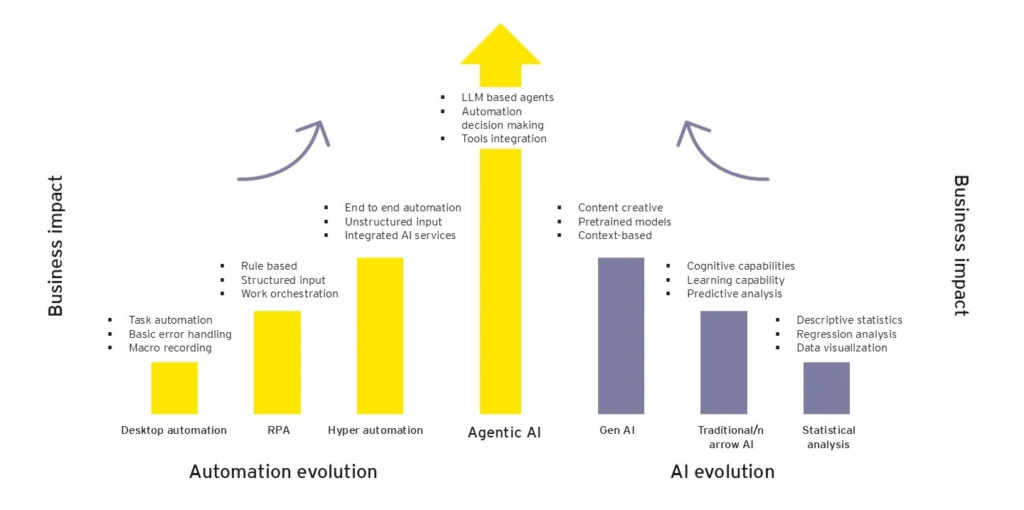
Agentic AI represents Large Language Model (LLM)- Driven, autonomous automation systems that integrate modern tooling ecosystems, web searching capabilities, and context-aware databases to dynamically complete desired tasks. As the next frontier of automation shifts toward empathetic AI agents, businesses can finally build lasting brand connections by delivering deeply personalized, 24/7 customer experiences at scale. Unlike traditional AI, agentic automation independently plans, decides, and executes complex multi-step workflows with minimal human oversight.
You can think of it as an intelligent digital workforce that works with your entire technology stack to facilitate basic task automation and RPA work orchestration, combined with cognitive capabilities and context-awareness.
How Agentic AI is Changing The Way Intelligence is Delivered?
Traditional automation delivers intelligence based on pre-determined rules, schedules, and human-initiated queries. However, with Agentic AI automation, you always have access to intelligence that continuously monitors, analyzes, and acts on changes without waiting for executive requests. This proactive intelligence delivery offers the following benefits:
- Amplified Autonomy
Agentic AI systems operate entirely on their own and across entire business processes without constant human supervision. By leveraging AI-driven agents that proactively manage schedules and coordinate time zones, the next frontier of automation will finally make remote work feel effortless. Unlike generative AI, which requires someone to input prompts and trigger actions or automation solutions that schedule tasks, AI Agents are capable of recognizing what needs to be done and when intervention is needed, automatically course-correcting as needed.
Read: Breaking Down Barriers: How Custom Software Empowers Small Businesses
- Better Decision Velocity
With Agentic AI automation, you can compress your decision cycles from days to minutes. These systems continuously process relevant data streams and environmental changes to respond to time-sensitive requirements, acting exactly when critical decisions need to be made.
In contrast, traditional RPA or automation may require input from a response team, which can take several hours or even days of analysis and coordination before implementing a change.
- Enhanced Flexibility and Precision
Agentic process automation adapts to changing business requirements without requiring new programming or rule updates. So instead of flagging an issue or alerting teams, Agentic AI systems evaluate the situation, compare all potential workarounds, and implement the best possible solution.
These systems can also reason spontaneously if encountering an unexpected scenario, something that traditional automation systems break down while doing. The precision comes from their contextual understanding, which gives them the flexibility to go beyond predefined actions.
- Increased Intuitivity
Agentic AI solutions include context-aware databases that enable real-time, highly accurate information retrieval based on semantic understanding rather than exact keyword matching. Instead of having to query data in a structured format, leaders can simply ask direct questions and receive comprehensive responses that automatically draw from relevant data sources.
In fact, more advanced Agentic AI systems can directly compare data based on desired parameters and give you the final comparative analysis. For instance, instead of querying what this document file contains, leaders can ask, “How has our understanding of this topic evolved across our knowledge base?” and the system will deliver the answer.
- Extended Reach
Traditional LLMs operate within the confines of their static training data, unable to access information beyond their knowledge cutoff or interact with external systems. In contrast, Agentic AI automation breaks these boundaries by actively searching the web, calling APIs, querying databases, and monitoring real-time data streams from IoT devices, social media feeds, and business systems.
This extended reach means these systems can fetch current market intelligence, regulatory updates, competitive moves, and operational metrics as they occur, allowing executives to base critical decisions on the most up-to-date available information.
Agentic AI in Practice: Where Does it Matter the Most
While agentic process automation has benefited every industry, certain sectors are experiencing transformational impact. In particular, industries where autonomous decision-making and real-time adaptation directly translate to a competitive edge, AI Agents have become integral.
Agentic AI in Cybersecurity
Agentic process automation in the cybersecurity sector is enhancing threat detection and reducing breach response times from hours to seconds. It has also strengthened overall security postures through spontaneous learning, particularly at a time when malicious actors are utilizing adaptive tactics, techniques, and procedures (TTPs) and AI/ML to exploit vulnerabilities.
- Real-time Threat Hunting: Continuously scans networks for suspicious patterns and isolates compromised systems.
- Vulnerability Management: Identifies security gaps, prioritizes patches based on risk assessment, and applies updates during maintenance windows.
- Incident Response Orchestration: Coordinates multi-system responses to breaches, preserves forensic evidence, and implements containment measures.
- Adaptive Security Protocols: Updates firewall rules, access permissions, and monitoring parameters based on emerging threat intelligence.
Agentic AI in Healthcare
Agent-based clinical decision support and administrative automation are enabling physicians to focus on complex patient care while ensuring consistent, evidence-based treatment protocols across all cases.
- Clinical Decision Support: Analyzes patient histories, symptoms, and medical literature to recommend treatment protocols and flag potential drug interactions.
- Administrative Workflow Automation: Manages appointment scheduling, insurance verification, prior authorizations, and care coordination without staff intervention.
- Continuous Patient Monitoring: Tracks vital signs, medication responses, and recovery progress to automatically adjust treatment plans and alert providers to complications.
- Resource Optimization: Dynamically allocates staff, equipment, and bed capacity based on patient acuity levels and predicted admission patterns.
Agentic AI in Finance
With agentic process automation in finance, risk management, and compliance operations are becoming fully autonomous. This has enabled institutions to free up internal resources for more strategic work and innovation while bringing some of the most critical operations under one roof.
- Automated Compliance Monitoring: Continuously scans transactions for regulatory violations, generates required reports, and ensures adherence to changing regulations across jurisdictions.
- Dynamic Risk Assessment: Evaluates portfolio risk in real-time, automatically adjusts exposure limits, and rebalances investments based on market conditions.
- Fraud Detection and Prevention: Analyzes transaction patterns, identifies suspicious activities, and blocks fraudulent transactions while minimizing false positives.
- Algorithmic Trading Optimization: Executes complex trading strategies, adapts to market volatility, and manages liquidity while maintaining risk parameters.
Agentic AI for Marketing
Campaign performance optimization and customer engagement are becoming autonomous with AI Agents that continuously adapt strategies based on real-time customer behavior and market dynamics.
- End-to-end Campaign Management: Automates content creation, audience targeting, ad placement, and budget optimization across multiple channels simultaneously.
- Real-Time Personalization: Dynamically adjusts website content, product recommendations, and messaging based on individual customer behavior and preferences.
- Performance Optimization: Continuously analyzes campaign metrics, reallocates budgets between high-performing channels, and adjusts targeting parameters.
- Customer Journey Orchestration: Manages multi-touchpoint experiences, triggers personalized communications, and optimizes conversion paths based on behavioral signals.
Agentic AI in Manufacturing
The integration of Agentic AI platforms and tools in manufacturing setups has helped businesses achieve near-autonomous operations, from adapting manufacturing processes to controlling quality while maximizing throughput.
- Predictive Maintenance Orchestration: Monitors equipment performance, predicts failures, automatically schedules maintenance, and orders replacement parts before breakdowns occur.
- Dynamic Production Scheduling: Adjusts manufacturing schedules in real-time based on supply chain disruptions, demand fluctuations, and equipment availability.
- Quality Control Automation: Continuously monitors product quality, identifies defects, adjusts production parameters, and triggers corrective actions without human oversight.
- Supply Chain Optimization: Manages vendor relationships, negotiates contracts, monitors delivery performance, and automatically switches suppliers based on cost and reliability metrics.
Unlocking the Transformative Potential of Agentic AI: Building Bridges
Most implementations fail not because the technology doesn’t work, but because companies underestimate the organizational changes required. You must prepare ahead of implementing agentic process automation because it entirely transforms how work gets done.
Structured Agentic AI Governance
Start by defining what your agentic AI systems can and can’t do without calling you at 3 AM. Create simple decision trees that specify when the AI Agent should handle routine negotiations versus when it needs to escalate million-dollar contract decisions to senior leadership.
Robust Infrastructure
Your current IT systems probably weren’t designed for Agentic AI automation. So, prepare your IT infrastructure. Assess how ready your workforce and workflows are to integrate high-performing AI Agents without disrupting everything. Invest in the digital plumbing that lets Agentic AI actually do its job.
This means having an ecosystem where APIs don’t crash under load, a data infrastructure where context-aware databases are clean enough for AI to trust, and backup systems that keep operations running even if something falters.
You can consider partnering with a reputed service provider that specializes in building tailored AI Agents. These providers can evaluate your existing infrastructure and determine your digital maturity, assessing whether agentic process automation is feasible at the moment or if you need an infrastructure overhaul.
Upskilling and Reskilling
Build employee confidence in agentic process automation. They shouldn’t fear that AI will replace them, they should learn to direct AI Agents to handle the tedious compliance reports while they focus on growing and innovating. Train managerial-level employees to supervise Agentic AI systems. Make others familiar with scenarios where they can trust the system blindly and where they should proceed with caution.
Organizations should also consider hiring dedicated AI Agent developers who possess specialized expertise in multi-agent orchestration and autonomous system design. This approach not only accelerates implementation timelines but also enables existing teams to focus on business-critical functions while gradually acquiring AI-centric skills and experience. Specialized talent will make sure your agentic AI investment delivers immediate value while building internal capabilities for long-term success.
Towards the Next Frontier: What More to Expect of Agentic AI
What began as an experimental pilot has evolved into a production necessity that’s impacting all industries. Agentic AI has moved beyond proof-of-concept demonstrations to 100% autonomous systems that actively overtake operations and deliver intelligence at a pace (and scale) that was previously unfathomable.
In the coming years, you will witness agentic process automation become fundamental to businesses. Dismissing it as just another passing automation trend will put you far behind your competitors, trying to keep pace with operational advantages that simply cannot be achieved through traditional means.
Author’s Bio:
Amelia Swank is a seasoned Digital Marketing Specialist at SunTec India with over eight years of experience in IT industry. She excels in SEO, PPC, and content marketing, and is proficient in Google Analytics, SEMrush, and HubSpot.
